Vibe Coding Technical Debt: What Happens to Your Codebase at Month 6
Vibe Coding Technical Debt: What Happens to Your Codebase at Month 6
Vibe coding at 2am feels like magic. Six months later, the team sits down to estimate the next feature and the number doesn't make sense.
The code isn't broken. It works. It passes tests. It looks clean. But adding something new takes three times longer than it should, nobody fully understands why a function does what it does, and every change introduces side effects that show up in places that have nothing to do with what you touched.
That's vibe coding technical debt. And it doesn't work like the technical debt you already know.
This post covers what actually happens to a vibe-coded codebase between month 1 and month 12, why the debt compounds instead of stacking, and which week-one decisions determine whether you're rewriting everything at month 9.
Why Vibe Coding Technical Debt Compounds Instead of Stacking
Traditional technical debt is something you create consciously. You know you're taking a shortcut, you document it, you put it in the backlog. It's debt you chose to take on.
Vibe coding technical debt is different. You take it on without knowing it. The code looks correct, passes tests, deployed without errors. There's no moment where you made a conscious decision to cut a corner.
The difference between traditional tech debt and AI-generated tech debt
Classic technical debt grows linearly. Each rushed decision adds a little more friction to the next change. It's manageable if you pay it down as you go.
Vibe coding technical debt compounds exponentially because each change is made without the context of what came before it. The model that generated the code doesn't know why that module was built that way, what constraints existed, what was tried first and discarded. After 6–12 months of iteration, the result is a codebase that's effectively a black box. Changes become unpredictable. The only option is a full rewrite.
The "looks correct but isn't reliable" problem
Here's the core issue. 61% of developers acknowledge that AI-generated code looks correct but isn't reliable — and 82% of that same group say AI makes them code faster. Those two things coexist. That's the trust paradox of 2026.
Code that passes all your tests can have logical flaws that silently produce wrong results for months. Not bugs that crash. Errors that behave correctly under normal conditions and fail on the edge cases nobody tested.
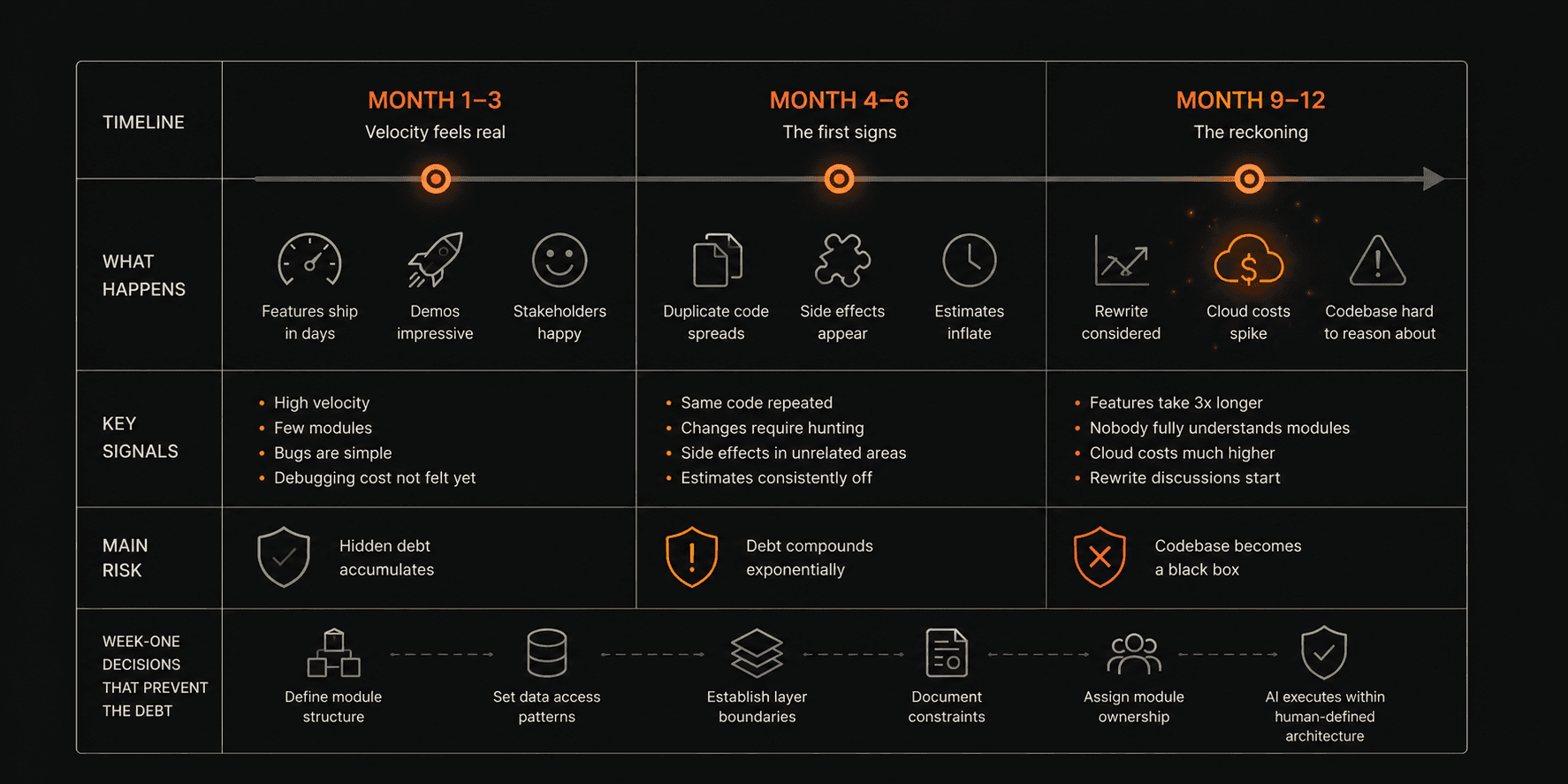
The 3-6-12 Month Timeline of a Vibe-Coded Codebase
There's no single moment when vibe coding technical debt appears. There's a progression. If you know what each stage looks like, you can intervene before a rewrite becomes the only option.
Month 1–3: Velocity feels real
The product moves at a speed nobody expected. Features that used to take weeks get done in days. Demos are impressive. Stakeholders are happy.
This is the period where 63% of developers say they spend more time debugging AI-generated code than they would have spent writing it themselves — but at this stage they don't feel it yet, because the code is new, there are few modules, and the problems are simple. The velocity is real. The cost isn't visible yet.
Month 4–6: The first signs
This is where the pattern starts showing up. You find the same database query copy-pasted across 15 different files. A change to the data model requires finding and updating all 15 copies — and if you miss one, you have a bug. Nobody put it there with bad intentions: the model generated what looked correct in each context, without knowing it already existed somewhere else.
Estimation times start inflating. Not dramatically, but consistently. Every feature touches modules whose behavior wasn't fully documented or understood. Side effects appear in places that shouldn't be related to what you touched.
Month 9–12: The reckoning
The team considers a partial or full rewrite. Not because the technology is outdated. Because the codebase has become genuinely difficult to reason about. Unoptimized database schemas and inefficient queries from AI-generated code can inflate cloud costs by up to 400% at production scale. What was saved in velocity upfront gets paid back with interest in infrastructure and engineering time.
This is the vibe coding reckoning that's happening at scale in mid-2026. It's not hypothetical.
Is Vibe Coding Technical Debt Inevitable?
No. But it requires making specific decisions in week one that most teams don't make — because in week one, the urgency is to move fast.
The difference between a product that maintains its velocity at month 6 and one that becomes impossible to maintain isn't the tools you used. It's whether someone defined architecture constraints before anyone started prompting.
A team that starts vibe coding without an architect who's defined module structure, data access patterns, and layer boundaries will produce a consistent codebase at month 1. It will be a problem at month 4. It will be a crisis at month 9.
A team that defines those constraints first — and then uses AI to execute within them — ships at the same speed at month 1 and at higher speed at month 6, because every change has context and every module has a clear owner.
The difference between vibe coding as a drafting tool and vibe coding as a delivery model is exactly that: whether the AI executes inside an architecture that a human engineer defined and understands, or whether the AI implicitly defines the architecture through what it generates.
The Week-One Architecture Decisions That Determine Month-Nine Vibe Coding Technical Debt
There are decisions that take one hour in week one and two sprints in week twenty. Those are the ones that get skipped most.
What gets decided in week one that most teams skip
Module structure. Data access patterns. How errors are handled. How observable the system is — logging, metrics, tracing. How external services integrate. How idempotent the critical operations are.
None of this is glamorous. None of it shows up in the demo. But these are the decisions that determine whether at month 6 you can add a feature without fear, or whether every change becomes an archaeology of code nobody fully understood.
AI-generated code consistently omits production-critical features — idempotency, observability, error handling, retries. Not because AI can't generate them. Because nobody explicitly asked for them, and the model optimizes for what appears to work in the normal case.
Why the pod structure matters here
At IMS, every build runs in pods: two developers, a PM, a designer, led by a senior engineer who sets technical standards from day one. That senior engineer isn't there to do code review at the end. They're there to make the architecture decisions in week one that make the code generated in weeks 2, 3, and 4 consistent, maintainable, and predictable.
The velocity our clients experience — Henry Roberts at MeasureAI describing a multi-model production system with YOLO/RT-DETR, CNNs, OCR, and ensemble logic and saying the team was "pumping these out, it's hard to keep up" — doesn't come from prompting faster. It comes from knowing exactly what to decide before you start prompting.
The full process is documented in how we ship AI products in 4 weeks. Velocity is the result, not the method.
What Does Production-Ready Vibe Coding Actually Look Like?
"Production-ready" is one of the most used and least defined phrases in the AI development ecosystem in 2026. Here's the definition we work with.
Bug Bash and pen testing as real governance
Two weeks before every delivery, IMS runs a Bug Bash: the team and the client sit down together and actively try to break the product. Not passive QA. Stress testing with the people who best understand how the system will be used under real conditions.
Then comes pen testing on critical features. Authentication, payment flows, integrations with external systems, anything handling sensitive data.
This isn't overhead. It's what separates a product that reached production from one that reached a demo. The gap between vibe coding as prototyping and vibe coding as delivery is exactly that governance layer most teams skip because it slows initial velocity.
The difference between a well-built prototype and one that looks well-built
A well-built prototype has explicit constraints from day one. You know what you intentionally didn't build, you can point to it, and you know exactly what you need to add to go to production.
A prototype that looks well-built appears complete, works in the demo, and carries invisible technical debt that won't show up until the first real user does something the demo didn't anticipate.
Most teams can't tell the difference between the two until they're already in production. That's why the pattern repeats: a prototype gets vibe-coded, stakeholders get excited, then engineers face a choice between rebuilding with real architecture or maintaining what's there.
When to Vibe Code Yourself vs. Bring in Professionals
The answer depends entirely on three variables: stakes, data sensitivity, and scale.
Vibe code it yourself when you're testing an idea, the cost of failure is low, there's no real user data, no payments, and no compliance requirements. A week of AI prototyping to validate whether the idea has traction is exactly what these tools were designed for.
Bring in professionals when the product handles real user data, processes payments, requires compliance, needs to scale, or when bugs have a cost. The cost of hiring well — typically $50K–$150K for a solid MVP — is a fraction of the cost of a rewrite, a security breach, or churn from unreliability.
The clearest framework we've seen in the market in 2026: validate with vibe coding, build with professionals. Spend two weeks proving the idea works with an AI-generated prototype. If it gains traction, invest in building it properly. You spent $1K on vibe coding instead of $100K on a product nobody wanted.
To see what this looks like in practice, the post on how we built the AI sprint planning tool that replaced standups shows what executing this distinction looks like on a real product.
Conclusion
Vibe coding technical debt is going to be one of the most expensive topics in the market through 2026 and 2027. Not because the tools are bad. Because most teams are using them without the architecture layer that makes AI-generated code maintainable at six months.
The products that survive that moment aren't the ones that got vibe-coded more carefully. They're the ones that had a senior engineer defining constraints in week one, a real QA process before production, and clarity about what was a prototype and what was a product.
That's the distinction we've been making across 50+ products at Imaginary Space. AI gives you real speed. Architecture determines how long it lasts.