Why Enterprise AI Adoption Fails in 2026 (And What the 8.6% Who Made It to Production Did Differently)
Why Enterprise AI Adoption Fails in 2026 (And What the 8.6% Who Made It to Production Did Differently)
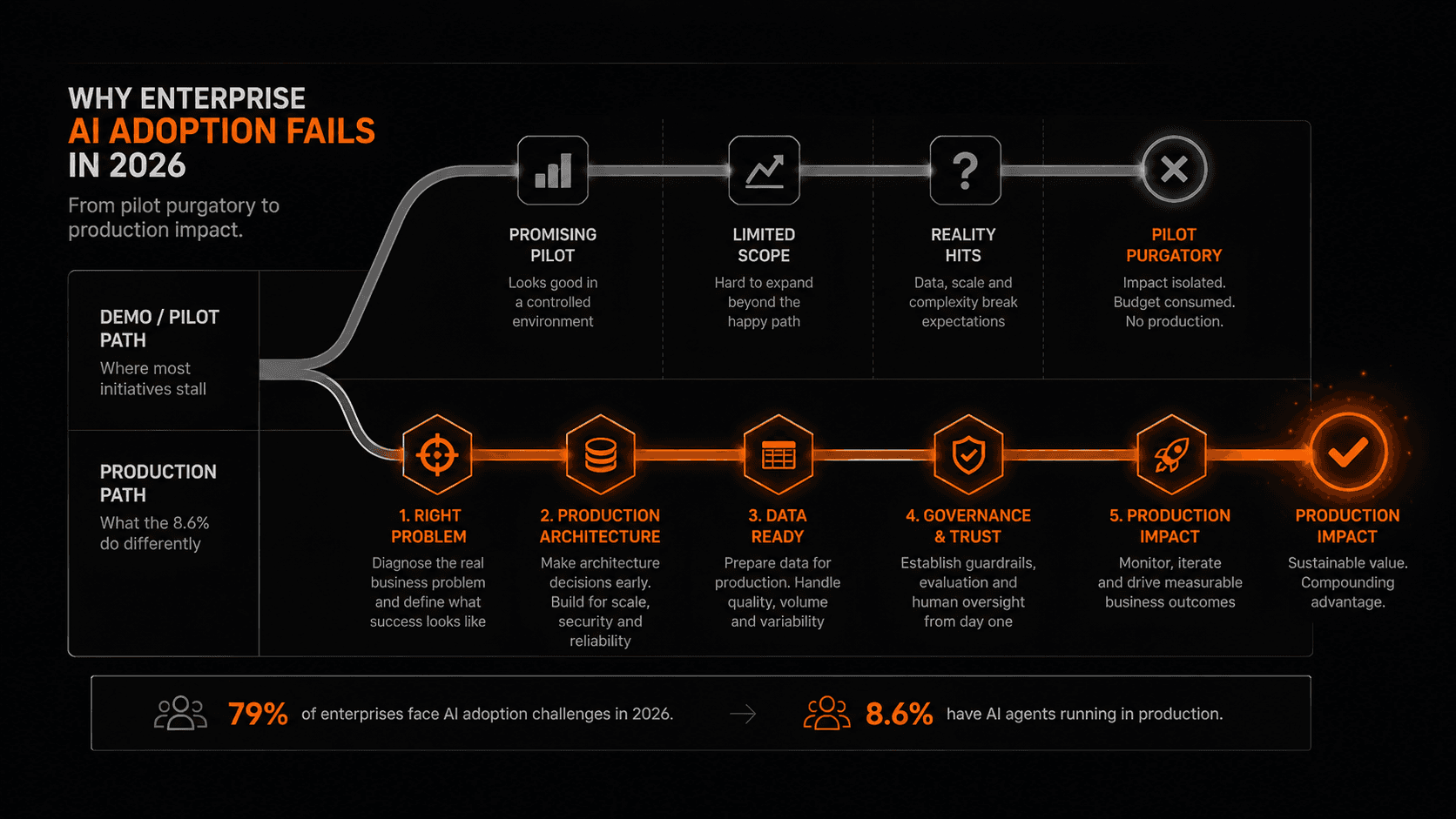
Enterprise AI spending crossed $300 billion in 2025. AI appeared in the strategic priorities of virtually every Fortune 500 annual report. And yet, only 8.6% of companies have AI agents running in production — while 63.7% report no formalized AI initiative at all.
The math doesn't add up. The money is there. The tools exist. The talent has been hired. So why are most organizations still running experiments in 2026 while a small group of companies has moved on to building actual systems?
The honest answer is that enterprise AI adoption doesn't fail because the technology doesn't work. It fails in the gap between what makes a pilot succeed and what a production system actually requires. Those are structurally different conditions, and treating them as the same problem is where most organizations go wrong.
The Pilot Purgatory Problem
There's a name for where most enterprise AI initiatives end up: pilot purgatory. It's not failure, it's something more expensive. Work is being done. Progress is being reported. Budgets are being consumed. But impact stays isolated, and the pilot never reaches the operational environment where it would need to perform under real conditions.
A recent analysis of enterprise AI initiatives found that 42% of US companies scrapped most of their AI projects in 2025 alone. MIT's Project NANDA found that 95% of generative AI pilots delivered zero measurable P&L impact. These are not numbers from organizations that weren't trying. They're from organizations that were trying in the wrong sequence.
Why pilots succeed in conditions that don't exist in production
Pilots are engineered for controlled success. The data scientists running them know which records to exclude, which values to trust, and which edge cases to handle manually. They make these calls based on domain knowledge acquired during the pilot, and document none of it, because the pilot is a demonstration, not a system.
When the production deployment needs to process data at volume, without the manual curation the pilot relied on, performance degrades to a level that would have killed the pilot if evaluated on the same data. The technology didn't change. The conditions did.
What pilot purgatory actually costs
Deloitte's 2026 State of AI in the Enterprise report names a specific compounding effect: organizations that cycle through multiple stalled pilots progressively lose the institutional momentum needed to complete a production transition. By the third failed pilot, executives stop attending reviews. Champions disengage. The fourth initiative launches into an organization that has already decided, implicitly, that AI doesn't work here. Gartner projects that 60% of AI projects lacking production-ready infrastructure will be abandoned through 2026. The cost isn't just sunk budget. It's the organizational credibility required to do the next thing.
The 5 Structural Challenges Blocking Enterprise AI Adoption
The failure patterns repeat across industries, team sizes, and budget levels. They are structural, not technical.
1. The diagnosis gap — wrong problem, right technology
Most enterprise AI projects start with a solution and work backward to a problem. A team identifies an AI capability, a model, a workflow, an agent, and builds a use case around it. What rarely happens is the harder work: defining exactly what problem the business needs to solve, what the current process actually looks like end to end, and what success would need to look like in production to matter to anyone.
Writer's 2026 enterprise AI adoption survey found that 54% of C-suite executives admit that adopting AI is creating internal conflict in their organizations. That tension is often a symptom of the diagnosis gap — multiple parts of the organization pursuing different definitions of the problem, with different expectations for what the system should do.
2. Architecture decisions deferred to the wrong phase
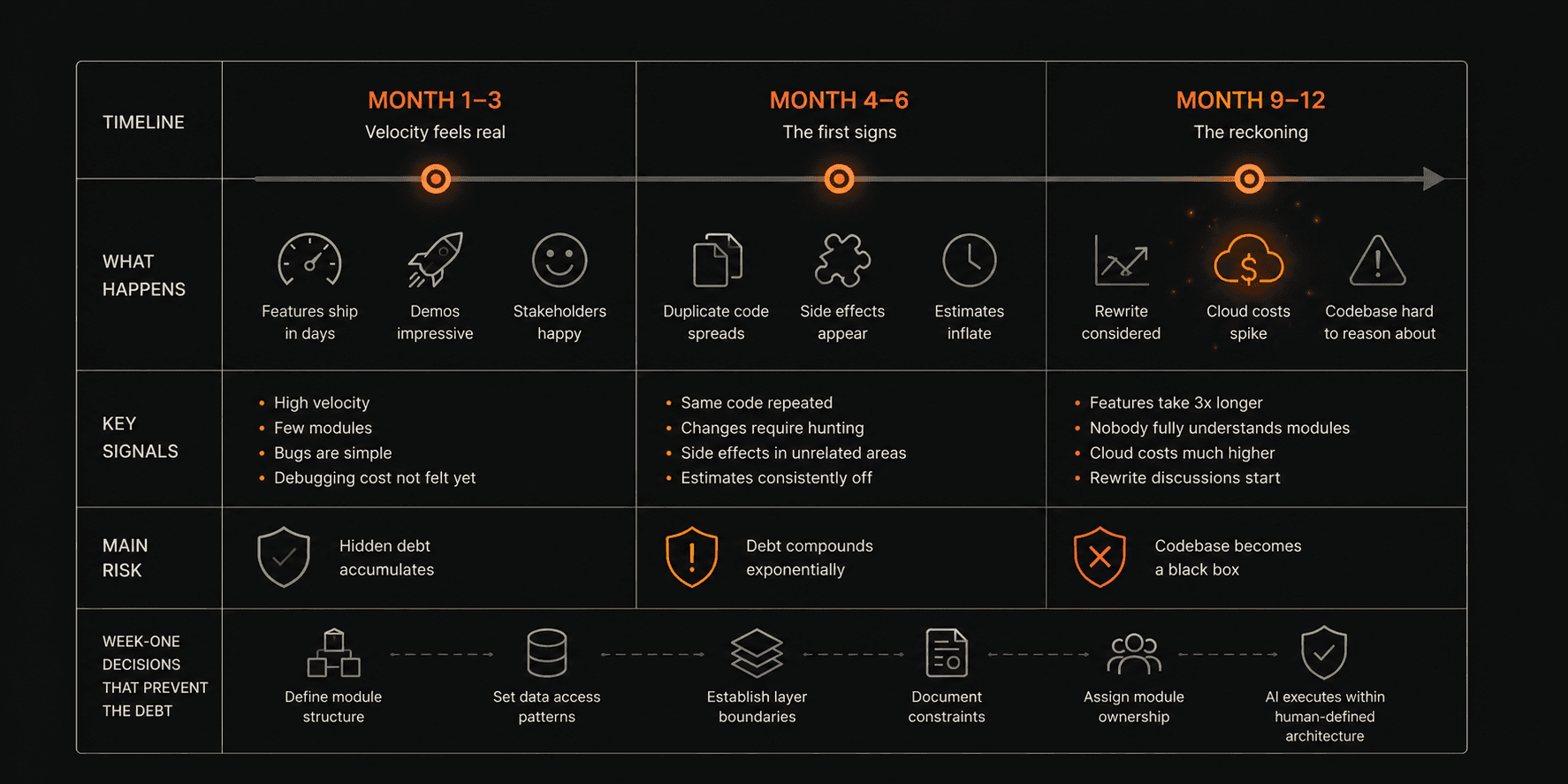
Production-ready AI systems require architecture decisions in week one, not after a pilot has proven the concept. Decisions about data pipelines, integration with existing systems, authentication, access controls, and failure modes don't get easier when made later — they get more expensive. Every week of pilot work built on the wrong foundation is work that gets rebuilt, or worse, work that ships in a state that can't scale.
This is the part that most organizations underestimate. The question isn't whether the model works. It's whether the environment the model runs in can support it reliably, at volume, over time.
3. Data that works in a sandbox, breaks in production
A Cloudera and Harvard Business Review study from March 2026 found that only 7% of enterprises consider their data completely ready for AI. That number should be alarming, because the data problem doesn't surface during the pilot — it surfaces in production. Pilots run on curated datasets. Production systems run on whatever data actually exists in the enterprise: legacy silos, inconsistent schemas, records that predate the schema entirely.
73% of organizations identify data quality as their top AI implementation challenge. That stat is almost certainly an undercount, because many organizations don't discover the scope of the problem until they've already committed to a timeline.
4. Governance overhead that wasn't in the business case
The original business case for an AI initiative typically calculates license cost plus training plus some estimate of labor savings. What it almost never includes is governance. Informatica's CDO Insights 2026 report found that three out of four organizations admit their governance hasn't kept pace with AI adoption, and 67% of executives believe their company has already experienced a data breach due to unapproved AI tool usage.
Governance isn't optional infrastructure. At enterprise scale, it's the thing that determines whether a deployed system can keep running, and whether the organization can control what it does when it doesn't perform as expected.
5. No production-ready infrastructure from day one
Gartner data shows that 44% of AI projects fail to move beyond pilot, with the primary reasons being unclear business objectives, poor data quality, and lack of executive sponsorship. The underlying issue connecting all three is the same: the project was designed to succeed as a pilot, not to become a system. Production-ready infrastructure — the architecture, the data pipelines, the integration layer, the security posture — requires intentional design from the beginning. It can't be retrofitted onto a pilot that wasn't built to hold it.
Why Most Enterprise AI Projects Get the Sequence Wrong
The standard enterprise AI sequence looks like this: build a pilot, prove the concept, get budget approval, then figure out production. That sequence is backwards.
McKinsey's State of AI research found that organizations that achieve real EBIT impact from AI are three times more likely to redesign workflows end to end before deploying — not after. The pilot doesn't validate the workflow. It validates the model in isolation. The workflow is where production value actually lives, and redesigning it after the pilot is committed is where the cost compounds.
What the 8.6% who deployed in production did differently
The organizations that have moved beyond pilot purgatory share a consistent pattern. They picked a specific workflow, a specific team, a specific scope — and treated the first deployment as infrastructure for the next one, not as a one-time experiment. They made architecture decisions before touching the model. They defined what production success looked like — in measurable terms tied to business outcomes — before writing a line of code. And they treated governance as a design constraint, not a post-deployment checklist.
The technology those organizations used isn't different. The sequence is.
What Does "Production-Ready" Actually Mean?
This phrase gets used a lot. It means something specific.
A production-ready AI system is one that can process real data at volume, without manual curation, and produce reliable outputs within acceptable latency and error thresholds — while maintaining security, access controls, and auditability that meet the organization's compliance requirements. It's architecture that holds under load, code that scales without rework, and integrations that survive the messy reality of existing enterprise data environments.
At Imaginary Space, production-ready isn't a quality bar applied at the end of a build — it's a design constraint applied at the beginning. Every project runs through a structured pod: two engineers, a PM, and a designer, led by a senior engineer who sets the technical standard from day one. Two weeks before every delivery, the team runs a Bug Bash — sitting with the client to actively break the product before real users encounter it. Then pen testing on critical features. Then delivery.
That process exists because the distance between "it works in the demo" and "it works in production" is where most projects fail. When 53 Stations — a SignalFire portfolio company — brought us in to build their internal operations platform, the brief wasn't a pilot. It was infrastructure. As their team put it: "Rather than being an investing company we want to be an operating company that invests — and what you guys are helping us build is the operations behind our ability to invest." That's not an experiment. That's a production system with strategic stakes. It requires a different kind of build from day one.
How Do You Know If Your AI Initiative Is About to Stall?
Five signals worth checking before the next review cycle:
The pilot was designed to run on clean data, and nobody has mapped what the production data environment actually looks like. The architecture decisions — database, integration layer, authentication, deployment environment — haven't been made yet, and the pilot is already three months in. Success is defined as "the model performs well," not as "this workflow produces measurable business impact." There's no named owner for what happens after the pilot is approved. And governance — who controls the system, what it can access, how it fails — is a topic for a later conversation.
Any one of those conditions can stall a project. All five together describe most of the AI initiatives that don't make it to production.
What Enterprise AI Adoption Actually Requires in 2026
The organizations that are scaling AI in 2026 aren't doing it by running better pilots. They're doing it by treating AI deployment as infrastructure — something that needs to be designed for production from the first conversation, not retrofitted after a proof of concept.
That requires structural readiness before technical execution. It means defining the right problem before selecting the technology. It means making architecture decisions in week one, not after approval. It means treating data quality and governance as design constraints, not implementation details.
The role of the right build partner
For most enterprise teams, the gap between what they can prove in a controlled environment and what they can operate in production is a structural one — and closing it internally takes longer than the competitive window allows. The organizations moving fastest aren't necessarily the ones with the most AI talent in-house. They're the ones that brought in partners who have made this transition before, across multiple industries and use cases, and who build to production standards from the first day of engagement.
The question to ask any external partner is not whether they can build what you've described. It's whether they've shipped it in production before — and what broke when they did. That answer tells you whether you're getting a demo or a system.
The enterprise AI adoption problem in 2026 is not a technology problem. The models work. The tools exist. What most organizations haven't solved is the translation layer between a controlled experiment and a live operational environment — and the structural conditions required to cross it.
The companies that will have real AI infrastructure running at the end of 2026 are the ones that stopped treating deployment as the last step and started treating it as the design constraint everything else is built around.
Imaginary Space is an AI-native product studio. We've shipped 50+ AI products for enterprise teams and VC-backed startups — from pilot to production, on client infrastructure, built to last.